
eRacks Systems Tech Blog
Open Source Experts Since 1999
The Price You See Is the Price: Transparent Server Pricing in a Shortage
This month, one of our distributors repriced a GPU by 29 percent. Overnight. The same card, quoted to us on a Thursday, cost $280 more on Friday. Server-grade DDR5 ECC memory (error-correcting code memory, the kind servers use to detect and fix bit errors) is running $24 to $28 per gigabyte on the street, roughly triple what it cost before the 2026 memory shortage. Enterprise hard drives jumped too.
In a market like this, most server vendors reach for the same three tricks. We think you should know what they are, because we built our whole pricing system to do the opposite.
The three tricks
The teaser config. The advertised price quietly assumes last year’s components: less memory than the workload needs, a boot drive standing in for storage, a processor two generations back. The real configuration costs thousands more, which you discover after you are invested.
“Call for pricing.” If the vendor will not put a number on the page, the number depends on who is asking. That is not pricing, that is negotiation, and it always favors the side with more information. That is never the buyer.
The silent quote. A price quoted in a volatile market is a bet. Some vendors let you carry a stale quote right up to the purchase order, then “revise” it when backing out is hardest.
What we do instead
The configurator price is the price. Every configuration on eracks.com produces a real, orderable number, computed from what the components actually cost us. No “starting at” games: change the memory, the drives, the GPUs, and watch the price move in both directions, up and down, with the parts market.
Robots watch the market so the catalog stays true. Automated trackers re-check memory, drive, and GPU street prices daily and weekly, and feed re-pricing that a human reviews before it ships. When a component spikes, we re-price openly rather than let the old number quietly stop being true.
When a build goes underwater, we fix the build in the open. This week our own margin checks flagged two NAS models whose entry configurations no longer made sense at current drive prices. We did not pad the price and we did not gut the spec quietly. We changed the default drive count, published the same price, and left every larger configuration exactly where it was. The entry price stayed real.
Quotes tell you everything up front. As of this month, every formal eRacks quote carries five things: your discounts by name, a validity window, a component-volatility note, an estimated lead time (in this market, chassis allocation is a real thing, and you deserve to know it before you order), and a configuration that matches a product we actually ship today. That last one sounds obvious. It is not industry practice.
When we cannot source a part at a price we can stand behind, we say so. Some configurations show “get a quote” instead of a number. That is not coyness. It means the market for that part is moving too fast for a printed price to stay true, so we price it fresh, with a validity window, when you ask.
Why bother
Earlier this year a prospect told us one of our configurations looked misleading. We did not enjoy hearing it, and he had a point: a stale page had drifted out of sync with the parts market. That critique turned into the system described above: automated price tracking, margin floors, re-verified defaults, and the five-line quote rule. The fix for being wrong is not better wording. It is better plumbing.
We have been building open-source servers since 1999. No venture capital, no lock-in, no per-seat fees, and nothing in the business model that needs a pricing trick to work. In a shortage, transparent pricing is slower and occasionally embarrassing. It is also the only kind worth publishing.
Configure anything, from a ZFS NAS to a private AI server, and the number you see is the number. If your workload does not fit a page, ask us and you will get a quote with all five lines on it.
joe July 20th, 2026
Posted In: News
Tags: AI server, DRAM shortage, NAS, no lock-in, Open Source, quotes, server pricing, supply chain, transparent pricing
Private AI Servers, Restructured: The New eRacks Good, Better, Best Ladder
We have restructured the eRacks private AI server line into a clear Good, Better, Best ladder. The goal is simple: whatever size model you want to run, there is one obvious system for it, at a price that reflects what is actually inside the box. Prices on the mid-tier dropped substantially from the old line, because the new systems use current-generation parts and are sized honestly for the work.
First, the framing. Private AI means running large language models (LLMs, the software behind AI assistants) on hardware you own, inside your own building. Your prompts, your documents, and your model outputs never touch a cloud provider. You buy the system once, and there are no per-seat or per-token fees afterward. Every system in the line is air-gap ready (able to operate with no internet connection at all), which matters for legal, medical, financial, and government work.
Good: AILSA 2U, from $5,995
The AILSA is the entry point. It is a 2U system (a U is 1.75 inches of rack height) assembled, burned in, and certified by eRacks, with Intel Arc GPUs (graphics processing units, the chips that run AI models). The base build carries two Arc B50 low-profile cards for 32GB of VRAM (the GPU’s onboard memory, which holds the model), with larger Arc Pro options available in the configurator. It handles 70B-class models (roughly 70 billion parameters), which covers most private chat, coding, and RAG workloads (retrieval-augmented generation, where the model answers from your own documents).
Better: AISLING 4U, from $16,995
The new AISLING is the workhorse of the line. It pairs a 24-core AMD Threadripper 9960X with 128GB of ECC memory (error-correcting code memory, which detects and fixes memory errors) and a single 1600W power supply. The 4U chassis takes up to three dual-slot GPUs, which means 96GB of total VRAM with Intel Arc Pro B70 cards. That is enough headroom to run a 70B-class model at higher precision, serve more simultaneous users, or hold longer context windows.
Best: AILEEN 4U, from $21,995
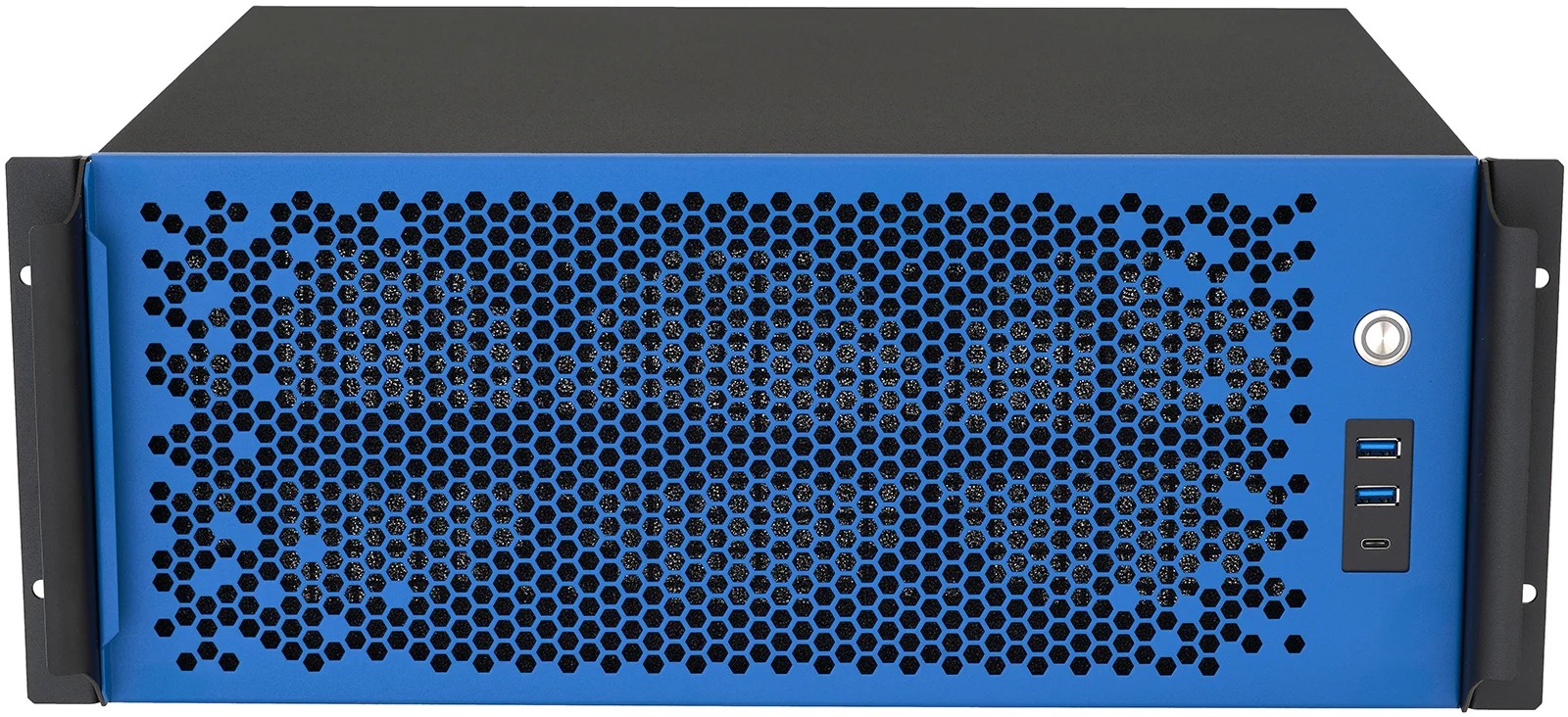
The new AILEEN steps up to server-class silicon: a 32-core AMD EPYC 9355 with 12 memory channels and 192GB of ECC memory. The extra memory bandwidth feeds the GPUs and speeds up CPU-side work like document indexing. It takes up to four GPUs for 128GB of VRAM, and it has redundant 1+1 power (two supplies, either one can run the system alone). AILEEN also ships in custom colors: blue, black, white, or red. The blue unit is the one pictured here.
| Model | Form factor | GPU memory (VRAM) | From |
|---|---|---|---|
| AILSA | 2U | 32GB base, larger Arc Pro options | $5,995 |
| AISLING | 4U | up to 96GB (3 x Arc Pro B70) | $16,995 |
| AILEEN | 4U | up to 128GB (4 GPUs) | $21,995 |
The enterprise tier
Some buyers need validated OEM server systems rather than our eRacks-Certified workhorse builds, usually because their ops teams require out-of-band management (a dedicated channel for remote hardware control, such as IPMI, that works even when the operating system is down). For them, the AIDAN 2U EPYC starts at $13,895, and the AISHA 4U starts at $30,995 with support for up to 10 GPUs.
What every system includes
All five models ship with Ubuntu LTS and the open-source AI stack pre-installed: Ollama, Open WebUI, vLLM, llama.cpp, and PyTorch. Each unit is burned in (run under sustained load before shipping) and tested. You get browser access to your own models on day one: unbox, rack, log in.
Not sure which tier fits? Start with our private AI sizing guide, which walks through how much GPU memory and system RAM a given model actually needs. Then configure the system that matches.
joe July 5th, 2026
Posted In: AI Servers, News
Tags: AI server, AMD EPYC, AMD Threadripper, GPU server, Intel Arc Pro, Ollama, open source AI, private AI, self-hosted LLM, vLLM