
eRacks Systems Tech Blog
Open Source Experts Since 1999
The Apps Were Never the Box: Why We Build Open NAS Systems

An XDA Developers writer published a piece last week that we could have written ourselves. He kept his Synology NAS (network-attached storage: a box of drives on your network that serves files and apps) and walked away from almost every app Synology ships with it. His photos moved to Immich, his music to Navidrome, his movies to Plex and Jellyfin, his documents to Paperless. All of them run in Docker, a way to package an app with everything it needs so it runs the same on any Linux machine.
His reasons are specific. Synology Photos, in his words, is “pretty dated”: no major new features in a while, and missing the GPS tagging, import workflows and shared libraries Immich has, with a mobile backup he found less reliable. Synology’s music app is “not very good at all”. And Synology discontinued its own video streaming app, which leaves a basic DLNA server as the only first-party option.
We have been saying this for years. It is worth saying why.
A NAS is two things
Every NAS is storage plus the apps that use it. Appliance vendors sell the two as one product, and for a while that was a fair trade: the apps were the reason to buy the box. Docker ended that. The open-source apps now move faster than the vendors’ own, which is the writer’s first reason, and because they are containers, they do not care which hardware they run on.
The XDA writer makes the point himself. His apps are “as independent as possible”, so if he moves from Synology to another brand, or to his own server, Immich comes with him. A proprietary app cannot make that promise, and neither can a vendor that decides which of its own apps survive the next release.
Once the apps are open, the box is just storage. And storage should be open too.
What open storage looks like
This is how we build NAS systems, and have for a long time:
- ZFS by default. ZFS is an open-source file system that checksums every block, so it detects and repairs silent corruption instead of serving it back to you. Our NAS line defaults to RAIDZ2, dual parity: any two drives can fail without losing data.
- The drives talk to ZFS directly. We offer an HBA (host bus adapter, the card the drives plug into) in IT mode, which passes each drive straight through instead of hiding it behind a hardware RAID controller. ZFS sees the real disks and their health.
- Standard NAS drives. Our current default is the 24TB Seagate IronWolf Pro, a CMR drive (conventional magnetic recording, the kind that behaves well in a rebuild), bought in the channel like any other part. If a drive fails in year four, you buy another one anywhere.
- Your choice of operating system. Ubuntu LTS by default, or Debian, TrueNAS Community Edition, OpenMediaVault and others. The data outlives the choice: a ZFS pool exported from one machine imports on another running a current OpenZFS.
- Sizes that fit the job. From NAS4, a 1U four-bay unit, to NAS100, 102 bays in 4U, plus the QUIET3 for a home or an office where a rackmount fan would be too loud.
The same apps, without the vendor in the middle
Immich, Jellyfin, Plex, Navidrome and Paperless run on any of these systems exactly as they run on the XDA writer’s Synology. The difference is what sits underneath: an operating system you can update on your schedule, a file system you can move, and hardware with no vendor deciding which parts or apps you may use. Name the apps you want and we install and test them before the system ships, the same way we set up TrueNAS with Jellyfin on a quiet media server this month.
To be fair to Synology: if you want an appliance you never think about, and you are happy with its apps, it is a reasonable buy. The writer still uses his as the backbone of his setup. But if you are already running your own apps, as he is, part of what the appliance price pays for is software you have stopped using.
Where to start
The full NAS line is configurable online, and our July post covers how we re-verified every default drive and part against this year’s shortages. The XDA article is here.
Tell us what you store and which apps you run, and we will size it. Write to info@eracks.com, or start with a quote request.
joe September 24th, 2026
Tags: Docker, Immich, Jellyfin, NAS, Navidrome, Open Source, self-hosting, Synology, TrueNAS, ZFS
We Re-Verified Every NAS Default Against the 2026 Drive Shortage. Here’s What Changed.
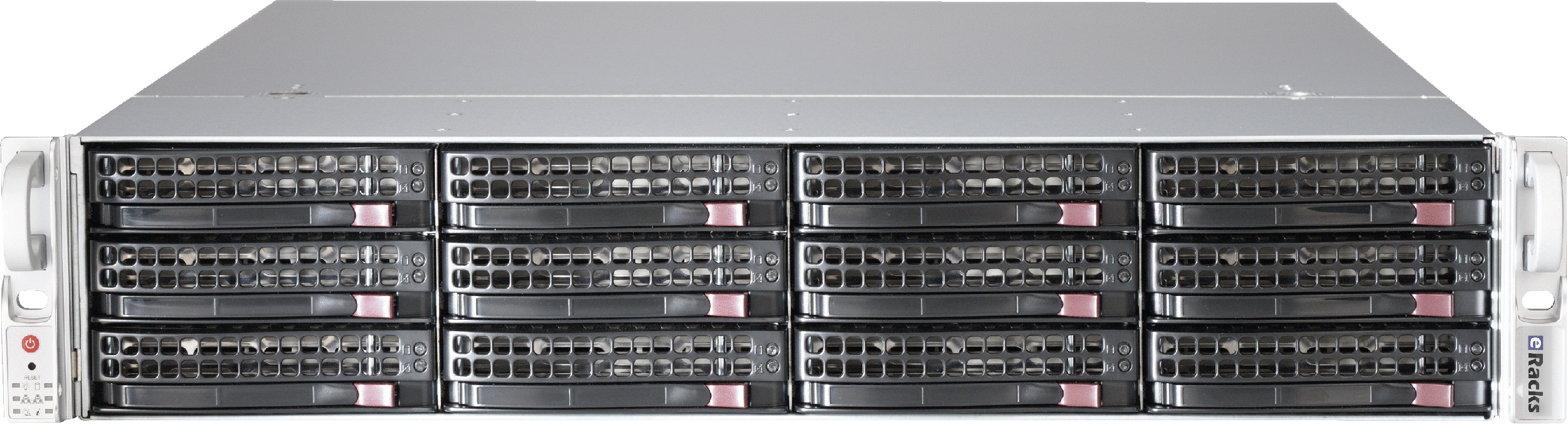
The 2026 drive and memory shortage has quietly broken a lot of storage price lists. Drives that vendors still advertise as standard are backorder-only at every national retailer. Memory prices moved 50 percent in a quarter. A configurator that hasn’t been re-checked against real supply this year is, politely, fiction.
So we re-verified our entire NAS line: every default component, checked against multiple named suppliers, for both price and actual in-stock availability. Here is what changed, and what it means if you’re shopping for storage this summer.
The 30TB drive problem
Our large NAS models used to default to the 30TB Seagate IronWolf Pro. It’s a fine drive, and it has become effectively unobtainable: backorder-only at the one national supplier still listing it, dropped from Seagate’s own current lineup, unavailable everywhere else we checked. Continuing to default to it would mean quoting systems we could not ship this week.
The fix: our high-capacity systems now default to the 24TB IronWolf Pro, in stock at multiple national retailers at about $35 per terabyte, and we added the 32TB IronWolf Pro, also in stock, at the top of the ladder at nearly the same cost per terabyte. Every drive in our NAS configurators remains CMR (conventional magnetic recording); we do not use shingled SMR drives, whose write performance collapses during the sustained writes of a RAID rebuild, exactly when you can least afford it.
ZFS RAIDZ2, now the default everywhere
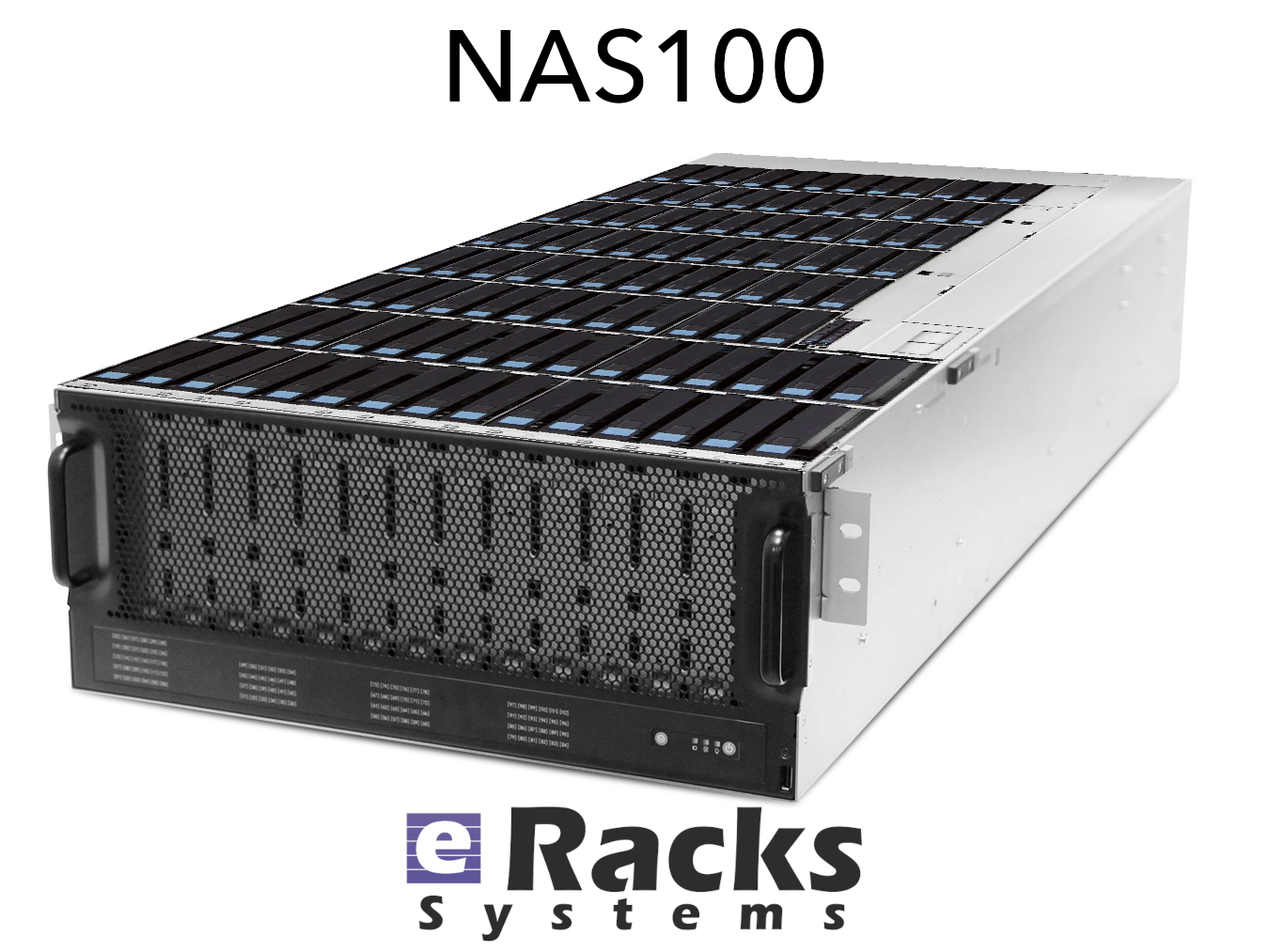
Every eRacks storage system, from the 1U four-bay NAS4 to the petabyte-class NAS100, now defaults to a ZFS RAIDZ2 pool: dual parity, meaning any two drives can fail without losing data. RAIDZ3 (triple parity) and striped mirrors (the performance-first layout) are right there in the dropdown, and traditional hardware RAID remains available for shops that require it, just never as a silent default.
Under every pool is an IT-mode HBA (a host bus adapter that passes drives directly to the operating system), because ZFS wants to see raw drives to do its end-to-end checksumming and self-healing. If you’re deciding between RAIDZ2, RAIDZ3, and mirrors, our free ZFS layout guide works through the math.
Prices that match what parts cost
Component costs moved, so prices moved: mid-size and large models are repriced to current reality (the NAS12 now starts at $8,995, the NAS72 at $25,995), and every price in the configurator reflects a component list we verified we can buy this week. The entry line held: the NAS4 still starts at $1,995 and the NAS6 at $2,995, now with 16GB of DDR5 standard and ECC memory available as an upgrade.
This is the same discipline we described on our refreshed Components We Use page: new parts only, authorized US distribution, multi-source price-and-availability checks before anything gets quoted, and a 72-hour burn-in before anything ships.
Browse the re-verified line at eracks.com/products/rackmount-nas-servers, or ask us to spec one for your workload, a human answers.
joe July 9th, 2026
Tags: CMR, drive shortage, IronWolf Pro, IT-mode HBA, NAS, RAIDZ2, supply chain, transparent pricing, TrueNAS, ZFS
Choosing a ZFS Layout for Your NAS: RAIDZ2, Mirrors, and the Top 5 Configs
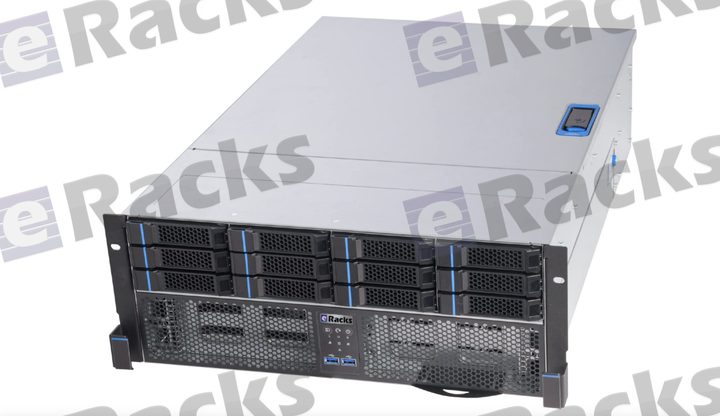
When we say our NAS line is “built right for ZFS” – IT-mode HBAs, ECC memory, CMR drives – the next question is always the same: which ZFS layout should I use? There’s no single right answer; it depends on your tolerance for failure, your need for speed, and how much usable capacity you want. Here’s how we think about it, and the five configs that cover almost everyone.
1. RAIDZ2 – the safe default
Double parity: any two drives in a vdev can fail and your data survives. For most NAS deployments of 6-12 drives, this is the right starting point – a strong balance of usable capacity and resilience, and enough margin to survive a second failure during a resilver (ZFS’s term for rebuilding the array onto a replacement drive — the riskiest window). If you’re not sure, choose RAIDZ2.
2. Striped mirrors (RAID10-style) – maximum IOPS
Pairs of mirrored drives, striped together. You give up half your raw capacity, but you get the best random-IO performance and by far the fastest resilvers (ZFS just copies one drive, not the whole vdev). The right choice for VM datastores, databases, and anything latency-sensitive.
3. RAIDZ1 – small arrays only
Single parity (RAID5-style). Fine for small pools (up to ~5-6 drives), all-SSD arrays, or less-critical data. We don’t recommend it for large modern HDDs: rebuild times are long enough that a second failure during resilver is a real risk, and RAIDZ1 can’t survive it.
4. RAIDZ3 – wide vdevs & archival
Triple parity – three drives can fail. Built for wide vdevs (12+ drives), archival and compliance data, and very large drives where resilver windows stretch into days. Maximum durability when you can spend a little capacity to get it.
5. dRAID – resilver speed at scale
For very large arrays (dozens of drives), dRAID distributes parity and spare capacity across all members, so a rebuild reads/writes in parallel across the whole pool instead of hammering one replacement disk. Resilvers that take days with traditional RAIDZ can finish in hours. Worth it once you’re past ~24 drives.
The pieces that make any pool better
Layout is only half the story. On the configurator you can add:
- NVMe special vdev – puts metadata and small blocks on flash; dramatic speedups for many-small-files workloads.
- SLOG – a fast, power-loss-protected device for synchronous writes (NFS, databases).
- L2ARC – an SSD read cache for hot data beyond what RAM holds.
- Plenty of ECC RAM – ZFS’s ARC lives in memory; more RAM = more cache, and ECC keeps it honest.
Every eRacks NAS ships with an IT-mode HBA option (no hardware RAID fighting ZFS), CMR drives up to 30TB, and TrueNAS SCALE / Proxmox / Ubuntu / Ceph pre-provisioned. Tell us your workload and we’ll spec the layout – and the special vdev / SLOG / L2ARC – to match.
Not sure which layout fits? Reply to this post – a real engineer will help you choose.
joe June 17th, 2026
Posted In: NAS Storage, News
Tags: dRAID, ECC memory, IT-mode HBA, L2ARC, NAS best practices, open source storage, RAIDZ2, RAIDZ3, SLOG, special vdev, striped mirrors, TrueNAS SCALE, ZFS
eRacks NAS, Rebuilt for Q2 2026: Xeon 6, 30TB CMR Drives, and Built Right for ZFS
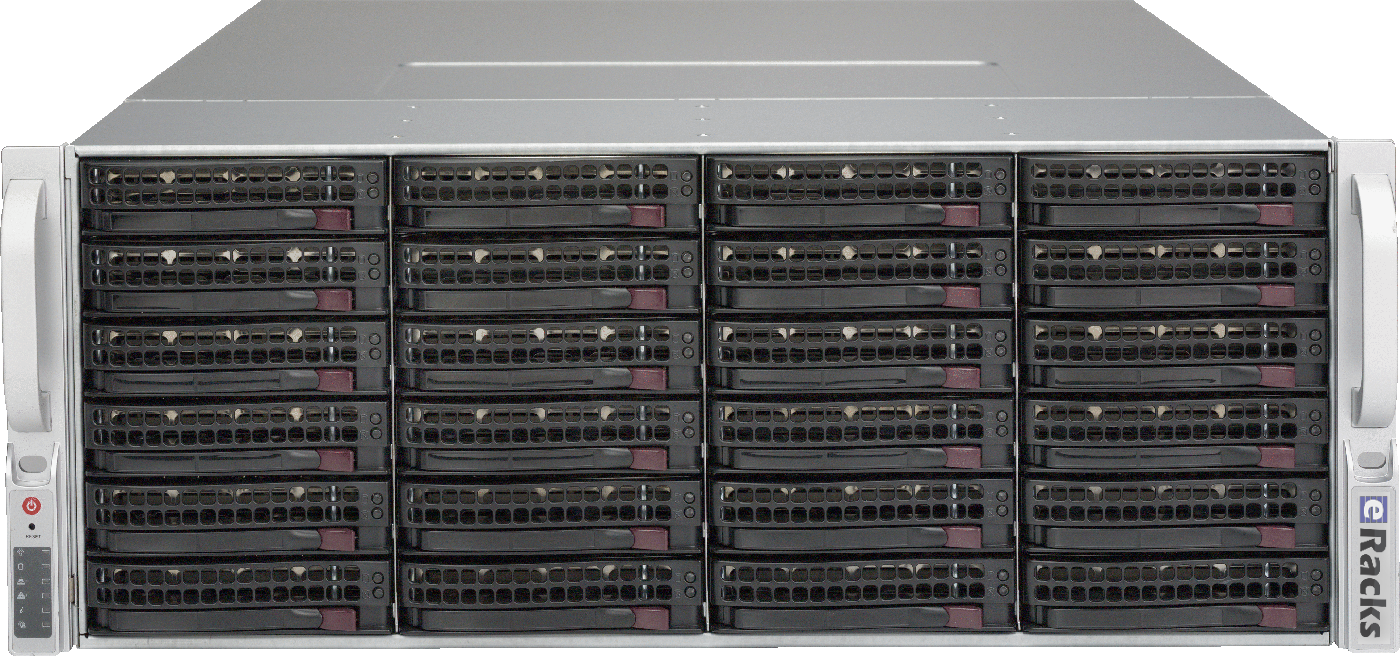
A NAS is only as good as the parts under the hood – and the parts that make a great ZFS server are not the ones most “NAS appliances” ship. So we went through the entire eRacks rackmount NAS line, from the NAS12 to the NAS100, and rebuilt it around what actually matters for modern open-source storage. Here’s what changed.
Current-Generation CPUs, the Way You’d Actually Spec Them
Every NAS now configures from a single CPU platform selector with current-generation silicon: Intel Xeon 6 – both Granite Rapids (P-core, for throughput) and Sierra Forest (E-core, for density and efficiency) – alongside AMD EPYC, with Ryzen and Threadripper available for workstation-class builds. Each platform is presented Good/Better/Best so you can pick the right core count without wading through a hundred SKUs, and the price reflects the real cost of that platform – a Ryzen build, for instance, comes in lower than a dual-socket Xeon 6.
CMR Drives Only – No SMR Surprises
ZFS and SMR (shingled) drives are a bad combination: SMR’s read-modify-write behavior turns a routine resilver into a multi-day ordeal. Our NAS line is CMR-only. The new default is the 30TB Seagate IronWolf Pro – the current dollars-per-terabyte sweet spot in NAS-class CMR – with conventional-recording options from a few TB up to the 32TB ceiling. No shingled drives ever sneak into a config.
Built Right for ZFS
Hardware RAID controllers and ZFS fight each other – ZFS wants direct, unmediated access to every disk. So every NAS offers an IT-mode HBA (no hardware RAID in the way), DDR5 ECC memory for a healthy ARC, and a RAID/pool selector that now includes ZFS directly alongside the traditional levels. Spin one up pre-provisioned with TrueNAS SCALE, Proxmox VE, Ubuntu, or Ceph – your choice, burned-in and tested before it ships.
Which ZFS Layout?
For most deployments we recommend RAIDZ2 (double parity – survives two simultaneous drive failures) as the default. Need maximum IOPS for VMs or databases? Striped mirrors. Very wide vdevs or archival data on large drives? RAIDZ3. We’ll help you match the layout – and the optional NVMe special vdev, SLOG, and L2ARC – to your workload.
One Line, Twelve Sizes
From the compact 1U NAS12 up through the petabyte-class NAS100, every model is built to order, burned-in, tested, and shipped ready to run. Pick your bays, pick your drives, pick your OS.
Questions about a build, or which ZFS layout fits your workload? Just reply – a real engineer answers.
joe June 14th, 2026
Posted In: NAS Storage, News
Tags: 26TB CMR, AMD EPYC, DDR5 ECC, Granite Rapids, Intel Xeon 6, IT-mode HBA, NAS servers, open source storage, rackmount NAS, RAIDZ2, Sierra Forest, TrueNAS SCALE, WD Red Pro, ZFS
Cameras Don’t Sleep: Why Surveillance and Healthcare Workloads Need a Different Kind of NAS
Most NAS conversations start with capacity: how many terabytes, how many drives, what does it cost per gigabyte. For a typical file server or backup target, those are the right questions. For surveillance, broadcast, and healthcare imaging workloads, they are the wrong questions – or at least, far from the only ones.
What unifies video surveillance, broadcast archives, healthcare PACS, and clinical research isn’t capacity. It’s the write pattern. These workloads write continuously, 24 hours a day, 7 days a week, with dozens or hundreds of concurrent streams. Consumer NAS drives, optimized for read-mostly home and small-office use, wear out two to three times faster under that load. Cloud storage solves the wear problem but introduces a different one: bandwidth costs at sustained ingest rates that quickly outpace any savings.
Why Surveillance Breaks Consumer NAS
Consider a modest IP camera deployment: 50 cameras, 4K resolution, H.265 encoding, 4 megabits per second average bitrate per stream. That works out to roughly 1.6 terabytes of new video written to storage every single day. Multiply by 30 days of retention and the active hot storage requirement is around 50 TB at any moment, with new data flowing in continuously.
That write pattern is fundamentally different from what consumer NAS drives are built for. Drives like WD Red Plus and Seagate IronWolf are optimized for the read-heavy workload typical of file sharing, media servers, and personal backup. Push them into 24×7 sequential write duty and the drive’s internal wear leveling, head positioning, and thermal management all get stressed in ways their firmware was not designed to handle. Manufacturers publish workload ratings for a reason: a 180 TB/year rating means exactly that, and surveillance workloads exceed it within months.
The Surveillance-Certified Drive Difference
WD Purple Pro and Seagate SkyHawk AI are different products. They are CMR (conventional magnetic recording) drives, not SMR, which matters because SMR drives perform catastrophically badly under sustained random writes. They carry workload ratings of 550 TB/year (Purple Pro) and 550 TB/year (SkyHawk AI), well above what 24×7 multi-camera deployments produce. Their firmware is tuned for the specific I/O pattern of camera writers: long sequential writes, frequent metadata updates, occasional reads when an operator scrubs back through footage.
Surveillance-certified drives also handle the thermal and vibration environment of a populated chassis differently. A 24-bay or 50-bay NAS with all bays writing simultaneously generates measurable rotational vibration; surveillance-rated drives compensate with internal sensors that consumer drives lack.
Networking Matters as Much as Drives
The other half of the surveillance storage equation is network throughput. Fifty 4K H.265 cameras at 4 Mbps each is 200 Mbps of aggregate ingest. That fits in gigabit Ethernet on paper, but headroom matters – encoded bitrate spikes during high-motion scenes, and a saturated link drops frames. An eRacks Video NAS ships with 25 or 100 gigabit Ethernet as a standard option, leaving plenty of room for both ingest and concurrent VMS playback or operator review without congestion.
Matching the System to the Scale
Honest pricing requires honest scale guidance:
- NAS8 ($4,995): 10 to 20 cameras, 4K, ~30 day retention. Branch office, small retail, smaller campus deployments.
- NAS24 ($8,995): 50 to 100 cameras with multi-week retention. The sweet spot for medium businesses, schools, and mid-sized municipal deployments.
- NAS50 ($14,995): 200+ cameras, broadcast archives, or long-retention security workloads. Large campuses, transit systems, broadcast facilities.
- NAS72 ($24,995): Petabyte-class surveillance backends, broadcast video archives, or city-wide CCTV.
None of these are “from $1,995 supports 1000 cameras” claims. The NAS4 entry tier is a real product for branch offices and small deployments; it is not a 1000-camera VMS backend, and pretending otherwise wastes the customer’s time and ours.
Where Healthcare Fits
The same architecture serves an adjacent vertical with surprising overlap. Healthcare PACS (Picture Archiving and Communication System) imaging produces a similar write profile: continuous, high-bandwidth, multi-source ingest with regulatory retention requirements that often exceed 7 years. Clinical research datasets, EMR (Electronic Medical Record) backends, and DICOM imaging archives all push storage hard in the same way camera systems do.
Where healthcare differs is the compliance overlay: HIPAA-aligned architecture means protected health information cannot leave the customer firewall, audit logging must be enabled at the filesystem level, and encryption at rest is non-negotiable. eRacks Healthcare NAS configurations ship with ZFS native encryption (AES-256), full Linux auditd logging, and SIEM forwarding hooks (Splunk, Elastic, Wazuh) configurable at build time. The hardware is the same VNAS; the OS configuration is the differentiator.
What This Looks Like in Practice
Cameras (or external NVR/VMS like Milestone, Genetec, or Frigate) write video files directly to the NAS over NFS, SMB, or iSCSI. The NAS handles all the storage logic: RAID, encryption, replication, snapshots. The VMS handles the recording schedule, operator interface, motion detection, and analytics. Separating these concerns means you can swap VMS software without re-buying storage, and you can scale storage independently of recording capacity.
For smaller deployments, optional VNAS configurations can ship with Frigate or ZoneMinder pre-installed, putting both storage and VMS on one box. For larger deployments, run VMS on separate hardware and use the VNAS as pure write-optimized storage.
Cost Comparison vs. Cloud
For a 50-camera deployment with 30-day retention, storage requirements are roughly 50 TB written per month with 100 to 200 TB of hot storage maintained continuously. AWS S3 Standard storage alone runs about $8,000 per year before egress charges; egress costs spike whenever an operator reviews footage or evidence needs to be exported. An eRacks/NAS24 at $8,995 with surveillance-certified drives is a one-time capital cost that handles the same workload and pays for itself inside year one, then runs for five-plus years with periodic drive replacements.
Configure or Inquire
The Video NAS and Healthcare NAS configurations are both available at eracks.com/products/rackmount-nas-servers/. Click any configuration link and the quote form arrives with vertical-specific notes pre-filled, so you can move quickly to capacity sizing and drive selection rather than starting from a blank form.
Questions about capacity sizing, drive choice, or network topology? Contact us with your camera count, expected retention, and average bitrate; we will spec it.
joe May 28th, 2026
Posted In: NAS Storage, News
Tags: 24x7 storage, Frigate, healthcare IT, HIPAA NAS, IP camera storage, NAS servers, PACS storage, Seagate SkyHawk AI, surveillance, Video NAS, VMS, VNAS, WD Purple Pro, ZFS, ZoneMinder