
eRacks Systems Tech Blog
Open Source Experts Since 1999
Cameras Don’t Sleep: Why Surveillance and Healthcare Workloads Need a Different Kind of NAS
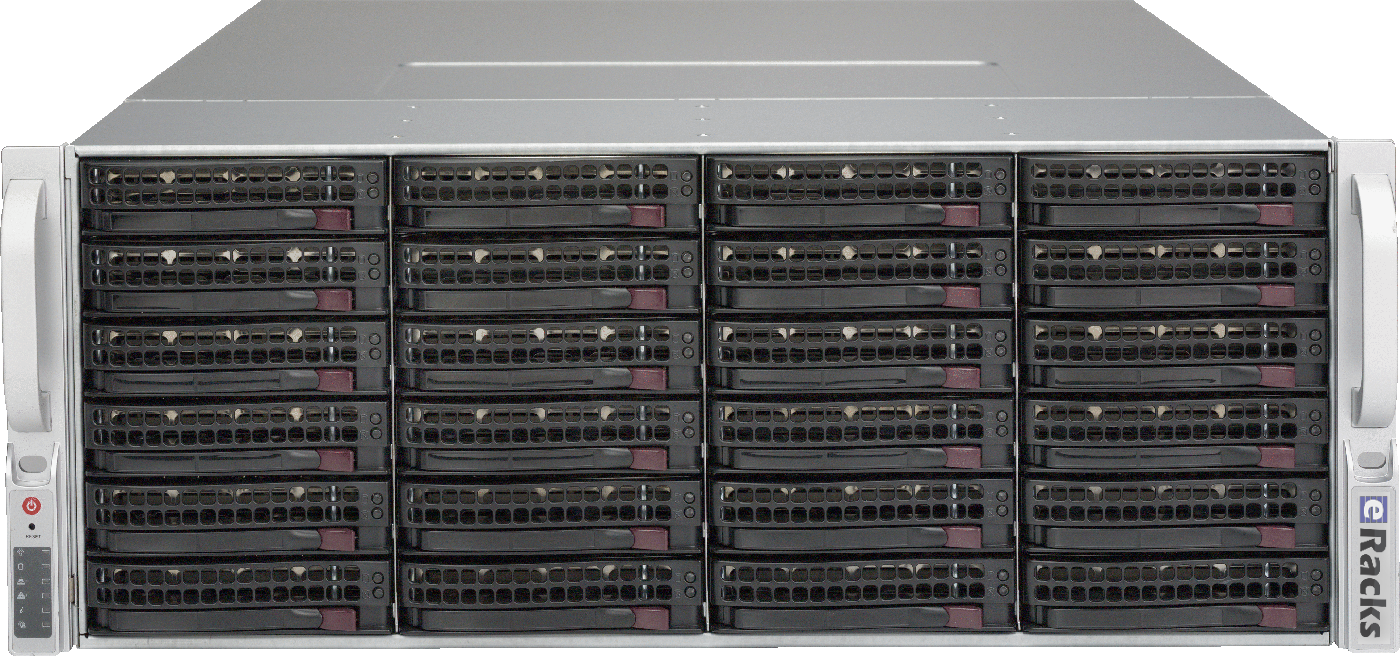
Most NAS conversations start with capacity: how many terabytes, how many drives, what does it cost per gigabyte. For a typical file server or backup target, those are the right questions. For surveillance, broadcast, and healthcare imaging workloads, they are the wrong questions – or at least, far from the only ones.
What unifies video surveillance, broadcast archives, healthcare PACS, and clinical research isn’t capacity. It’s the write pattern. These workloads write continuously, 24 hours a day, 7 days a week, with dozens or hundreds of concurrent streams. Consumer NAS drives, optimized for read-mostly home and small-office use, wear out two to three times faster under that load. Cloud storage solves the wear problem but introduces a different one: bandwidth costs at sustained ingest rates that quickly outpace any savings.
Why Surveillance Breaks Consumer NAS
Consider a modest IP camera deployment: 50 cameras, 4K resolution, H.265 encoding, 4 megabits per second average bitrate per stream. That works out to roughly 1.6 terabytes of new video written to storage every single day. Multiply by 30 days of retention and the active hot storage requirement is around 50 TB at any moment, with new data flowing in continuously.
That write pattern is fundamentally different from what consumer NAS drives are built for. Drives like WD Red Plus and Seagate IronWolf are optimized for the read-heavy workload typical of file sharing, media servers, and personal backup. Push them into 24×7 sequential write duty and the drive’s internal wear leveling, head positioning, and thermal management all get stressed in ways their firmware was not designed to handle. Manufacturers publish workload ratings for a reason: a 180 TB/year rating means exactly that, and surveillance workloads exceed it within months.
The Surveillance-Certified Drive Difference
WD Purple Pro and Seagate SkyHawk AI are different products. They are CMR (conventional magnetic recording) drives, not SMR, which matters because SMR drives perform catastrophically badly under sustained random writes. They carry workload ratings of 550 TB/year (Purple Pro) and 550 TB/year (SkyHawk AI), well above what 24×7 multi-camera deployments produce. Their firmware is tuned for the specific I/O pattern of camera writers: long sequential writes, frequent metadata updates, occasional reads when an operator scrubs back through footage.
Surveillance-certified drives also handle the thermal and vibration environment of a populated chassis differently. A 24-bay or 50-bay NAS with all bays writing simultaneously generates measurable rotational vibration; surveillance-rated drives compensate with internal sensors that consumer drives lack.
Networking Matters as Much as Drives
The other half of the surveillance storage equation is network throughput. Fifty 4K H.265 cameras at 4 Mbps each is 200 Mbps of aggregate ingest. That fits in gigabit Ethernet on paper, but headroom matters – encoded bitrate spikes during high-motion scenes, and a saturated link drops frames. An eRacks Video NAS ships with 25 or 100 gigabit Ethernet as a standard option, leaving plenty of room for both ingest and concurrent VMS playback or operator review without congestion.
Matching the System to the Scale
Honest pricing requires honest scale guidance:
- NAS8 ($4,995): 10 to 20 cameras, 4K, ~30 day retention. Branch office, small retail, smaller campus deployments.
- NAS24 ($8,995): 50 to 100 cameras with multi-week retention. The sweet spot for medium businesses, schools, and mid-sized municipal deployments.
- NAS50 ($14,995): 200+ cameras, broadcast archives, or long-retention security workloads. Large campuses, transit systems, broadcast facilities.
- NAS72 ($24,995): Petabyte-class surveillance backends, broadcast video archives, or city-wide CCTV.
None of these are “from $1,995 supports 1000 cameras” claims. The NAS4 entry tier is a real product for branch offices and small deployments; it is not a 1000-camera VMS backend, and pretending otherwise wastes the customer’s time and ours.
Where Healthcare Fits
The same architecture serves an adjacent vertical with surprising overlap. Healthcare PACS (Picture Archiving and Communication System) imaging produces a similar write profile: continuous, high-bandwidth, multi-source ingest with regulatory retention requirements that often exceed 7 years. Clinical research datasets, EMR (Electronic Medical Record) backends, and DICOM imaging archives all push storage hard in the same way camera systems do.
Where healthcare differs is the compliance overlay: HIPAA-aligned architecture means protected health information cannot leave the customer firewall, audit logging must be enabled at the filesystem level, and encryption at rest is non-negotiable. eRacks Healthcare NAS configurations ship with ZFS native encryption (AES-256), full Linux auditd logging, and SIEM forwarding hooks (Splunk, Elastic, Wazuh) configurable at build time. The hardware is the same VNAS; the OS configuration is the differentiator.
What This Looks Like in Practice
Cameras (or external NVR/VMS like Milestone, Genetec, or Frigate) write video files directly to the NAS over NFS, SMB, or iSCSI. The NAS handles all the storage logic: RAID, encryption, replication, snapshots. The VMS handles the recording schedule, operator interface, motion detection, and analytics. Separating these concerns means you can swap VMS software without re-buying storage, and you can scale storage independently of recording capacity.
For smaller deployments, optional VNAS configurations can ship with Frigate or ZoneMinder pre-installed, putting both storage and VMS on one box. For larger deployments, run VMS on separate hardware and use the VNAS as pure write-optimized storage.
Cost Comparison vs. Cloud
For a 50-camera deployment with 30-day retention, storage requirements are roughly 50 TB written per month with 100 to 200 TB of hot storage maintained continuously. AWS S3 Standard storage alone runs about $8,000 per year before egress charges; egress costs spike whenever an operator reviews footage or evidence needs to be exported. An eRacks/NAS24 at $8,995 with surveillance-certified drives is a one-time capital cost that handles the same workload and pays for itself inside year one, then runs for five-plus years with periodic drive replacements.
Configure or Inquire
The Video NAS and Healthcare NAS configurations are both available at eracks.com/products/rackmount-nas-servers/. Click any configuration link and the quote form arrives with vertical-specific notes pre-filled, so you can move quickly to capacity sizing and drive selection rather than starting from a blank form.
Questions about capacity sizing, drive choice, or network topology? Contact us with your camera count, expected retention, and average bitrate; we will spec it.
joe May 28th, 2026
Posted In: NAS Storage, News
Tags: 24x7 storage, Frigate, healthcare IT, HIPAA NAS, IP camera storage, NAS servers, PACS storage, Seagate SkyHawk AI, surveillance, Video NAS, VMS, VNAS, WD Purple Pro, ZFS, ZoneMinder