
eRacks Systems Tech Blog
Open Source Experts Since 1999
Private AI Servers, Restructured: The New eRacks Good, Better, Best Ladder
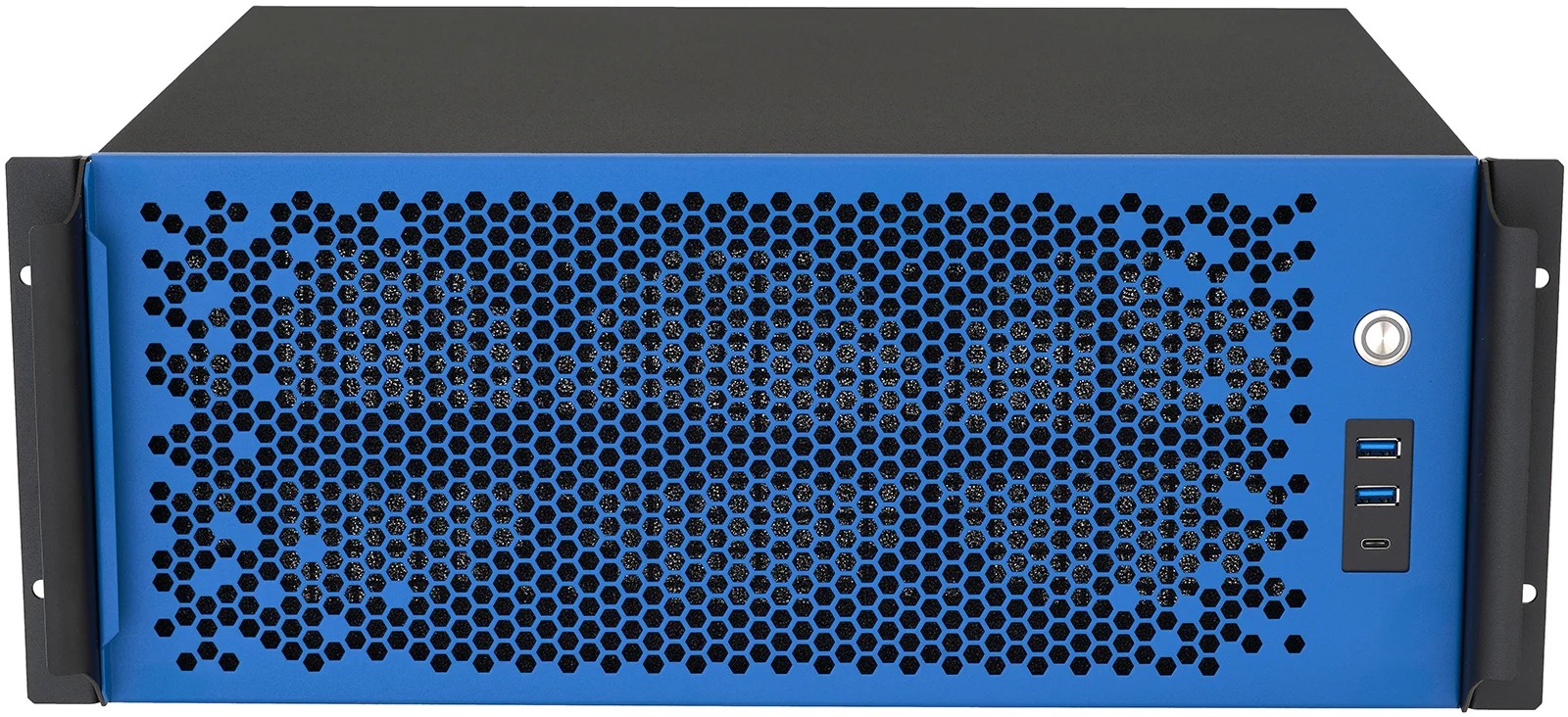
We have restructured the eRacks private AI server line into a clear Good, Better, Best ladder. The goal is simple: whatever size model you want to run, there is one obvious system for it, at a price that reflects what is actually inside the box. Prices on the mid-tier dropped substantially from the old line, because the new systems use current-generation parts and are sized honestly for the work.
First, the framing. Private AI means running large language models (LLMs, the software behind AI assistants) on hardware you own, inside your own building. Your prompts, your documents, and your model outputs never touch a cloud provider. You buy the system once, and there are no per-seat or per-token fees afterward. Every system in the line is air-gap ready (able to operate with no internet connection at all), which matters for legal, medical, financial, and government work.
Good: AILSA 2U, from $5,995
The AILSA is the entry point. It is a 2U system (a U is 1.75 inches of rack height) assembled, burned in, and certified by eRacks, with Intel Arc GPUs (graphics processing units, the chips that run AI models). The base build carries two Arc B50 low-profile cards for 32GB of VRAM (the GPU’s onboard memory, which holds the model), with larger Arc Pro options available in the configurator. It handles 70B-class models (roughly 70 billion parameters), which covers most private chat, coding, and RAG workloads (retrieval-augmented generation, where the model answers from your own documents).
Better: AISLING 4U, from $16,995
The new AISLING is the workhorse of the line. It pairs a 24-core AMD Threadripper 9960X with 128GB of ECC memory (error-correcting code memory, which detects and fixes memory errors) and a single 1600W power supply. The 4U chassis takes up to three dual-slot GPUs, which means 96GB of total VRAM with Intel Arc Pro B70 cards. That is enough headroom to run a 70B-class model at higher precision, serve more simultaneous users, or hold longer context windows.
Best: AILEEN 4U, from $21,995
The new AILEEN steps up to server-class silicon: a 32-core AMD EPYC 9355 with 12 memory channels and 192GB of ECC memory. The extra memory bandwidth feeds the GPUs and speeds up CPU-side work like document indexing. It takes up to four GPUs for 128GB of VRAM, and it has redundant 1+1 power (two supplies, either one can run the system alone). AILEEN also ships in custom colors: blue, black, white, or red. The blue unit is the one pictured here.
| Model | Form factor | GPU memory (VRAM) | From |
|---|---|---|---|
| AILSA | 2U | 32GB base, larger Arc Pro options | $5,995 |
| AISLING | 4U | up to 96GB (3 x Arc Pro B70) | $16,995 |
| AILEEN | 4U | up to 128GB (4 GPUs) | $21,995 |
The enterprise tier
Some buyers need validated OEM server systems rather than our eRacks-Certified workhorse builds, usually because their ops teams require out-of-band management (a dedicated channel for remote hardware control, such as IPMI, that works even when the operating system is down). For them, the AIDAN 2U EPYC starts at $13,895, and the AISHA 4U starts at $30,995 with support for up to 10 GPUs.
What every system includes
All five models ship with Ubuntu LTS and the open-source AI stack pre-installed: Ollama, Open WebUI, vLLM, llama.cpp, and PyTorch. Each unit is burned in (run under sustained load before shipping) and tested. You get browser access to your own models on day one: unbox, rack, log in.
Not sure which tier fits? Start with our private AI sizing guide, which walks through how much GPU memory and system RAM a given model actually needs. Then configure the system that matches.
joe July 5th, 2026
Posted In: AI Servers, News
Tags: AI server, AMD EPYC, AMD Threadripper, GPU server, Intel Arc Pro, Ollama, open source AI, private AI, self-hosted LLM, vLLM