
eRacks Systems Tech Blog
Open Source Experts Since 1999
The Future of Memory, and What It Means for Upgradeability
For thirty years the answer to “my machine needs more memory” was the same: open the case, push a stick into an empty slot. That answer is splitting three ways, and the split matters more than the speeds.
Three futures
Sealed. High Bandwidth Memory (HBM) is not a module at all. DRAM dies are stacked on top of each other, wired vertically through the silicon, and mounted on an interposer (a thin silicon layer that carries the wiring) millimeters from the processor, inside the same package. The bus is a thousand bits wide instead of 64, the distance is a fraction of an inch instead of several, and the result is the bandwidth that makes an AI accelerator an AI accelerator. NVIDIA’s H100 and Blackwell parts are built this way, and Intel put HBM on a Xeon (the Xeon Max) for the same reason. The trade is absolute: the memory is soldered into the package, so the amount you buy on day one is the amount you own on day one thousand. The industry name for this kind of assembly, several chips from several processes glued into one package, is System in Package (SiP). Your watch is one. So is the processor in the largest AI clusters.
Flat. JEDEC, the standards body behind every DIMM you have ever installed, published the CAMM2 standard (JESD318) in December 2023. A CAMM2 (Compression Attached Memory Module) is a flat card that screws down onto a bed of contacts instead of standing in a slot, which puts the memory closer to the processor and keeps the signal clean at higher speeds. The low-power version, LPCAMM2, is the interesting one: laptop makers used to solder LPDDR memory to the board to get its speed and battery life, and that killed upgrades. LPCAMM2 puts the same memory on a replaceable card. Lenovo’s ThinkPad P1 Gen 7 ships with up to 64GB of LPCAMM2 at LPDDR5X-7500, and it can be changed with a screwdriver. Desktop CAMM2 boards have been shown by the motherboard makers; volume is still small. The catch is that a CAMM2 is one module carrying both memory channels, so an upgrade means replacing it rather than adding a second stick.
Fabric. In servers, memory is leaving the motherboard. Compute Express Link (CXL) runs over the same physical lanes as PCIe and lets a system treat memory the way it treats a drive: something you add in a slot. A CXL memory expander is a card, or a box, of ordinary DDR5 that the processor sees as more RAM. Current AMD EPYC and Intel Xeon platforms support it, controller silicon is shipping, and the standard has kept moving; the CXL Consortium’s current specification is 4.0. Later revisions describe pooling, where a rack shares one large bank of memory and hands it to whichever server needs it, so capacity stops being stranded inside boxes that are not using it.
Why this is a purchasing question, not a spec-sheet question
We track memory prices every day because we quote servers every day. Measured as the best street price per gigabyte across the major memory lines, March 2026 to September 2026:
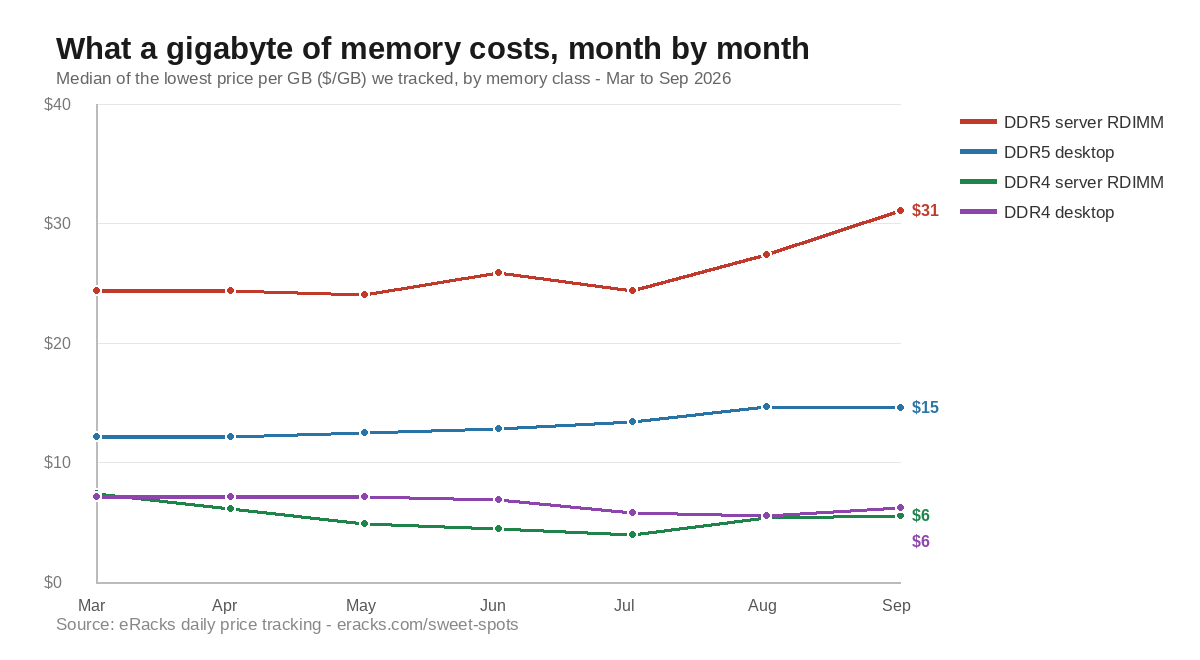
- DDR5 server memory (ECC RDIMM): $24.37 to $31.05 per GB, up 27 percent; the best available price went from $14.17 to $26.75, up 89 percent.
- DDR5 desktop memory: $12.19 to $14.58 per GB, up 20 percent.
- DDR4 server memory (ECC RDIMM): $7.44 to $5.56 per GB, down 25 percent.
- DDR4 desktop memory: $7.19 to $6.22 per GB, down 13 percent.
Two things follow. First, the memory you did not buy in March costs a third more today, and the cheap end of the market has closed up. Second, the previous generation is being liquidated: DDR4 server memory now costs a seventh of DDR5 per gigabyte. For a file server, a backup target, or a build server, where capacity matters and bandwidth does not, a DDR4 platform with its slots filled is the best value on the table this year.
In a sealed design none of this is available to you. You pay the day-one price for the day-one capacity, and a shortage or a glut in the memory market changes nothing about the machine you own. In a slotted design, or a fabric design, the market is your friend as often as your enemy: you buy the slots now, you fill them when the price is right.
What we do about it
Every quote we write shows the board’s slot count next to what the configuration fills, so the upgrade path is visible before the order rather than discovered after it. Some customers max the memory on day one, which is the right call for a machine with a known job; the AMD EPYC 9005 boards we build on carry 24 DIMM slots and up to 6TB, so there is usually room either way. The memory line in every quote is priced at that day’s street price from the same tracking above, so a customer who asks for 256GB today and 512GB in six months pays the market twice, not our guess once. And as CXL memory expanders reach the channel, they are quotable on the EPYC 9005 and Xeon 6 platforms as a third way to add capacity without touching a socket.
Sealed memory is the right design for an accelerator, where bandwidth is the whole point. For everything else, we would rather sell you the slots.
Prices are our own daily tracking of the lowest street price per gigabyte for each major memory line at Newegg, taken as the median across lines in each class; March 2026 versus September 2026.
joe September 17th, 2026
Posted In: News, servers, Technology
Tags: CAMM2, CXL, DDR4, DDR5, ECC RDIMM, EPYC 9005, HBM, memory price tracking, server memory prices, upgradeability