
eRacks Systems Tech Blog
Open Source Experts Since 1999
HAMR vs CMR: 32TB NAS Drives and What They Mean for Your Storage Budget
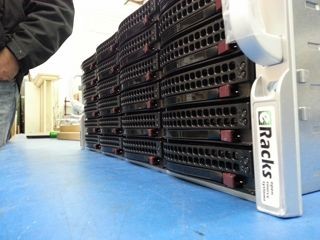
A quiet but significant update landed in the eRacks configurator this week: 32TB HAMR drives are now available across the full NAS product line. For organizations that measure their storage needs in petabytes, this matters. The 102-bay eRacks/NAS100 can now be configured with 3.264 petabytes of raw capacity in a single 4U chassis – up from 2.6PB with the previous generation of 30TB CMR drives.
That is not a rounding difference. It is an additional 664 terabytes in the same footprint, with no extra rack space, no additional power circuits, and no change to the chassis.
What HAMR Actually Means
Hard drives have been using conventional magnetic recording (CMR) for decades. In CMR, a write head magnetizes small regions of a spinning platter to store data. The physics of that process set a ceiling on how densely bits can be packed – push the magnetic grains too close together and they become thermally unstable, meaning data can corrupt itself over time.
Heat-Assisted Magnetic Recording (HAMR) breaks through that ceiling by using a tiny laser to briefly heat a precise spot on the platter to around 450 degrees Celsius at the moment of writing. At that temperature, the magnetic material becomes temporarily easier to flip, allowing much smaller, more stable grains to be written reliably. Once the spot cools – which happens in nanoseconds – the written data is locked in place more durably than conventional CMR recording allows.
The practical result is higher areal density: more data per square millimeter of platter surface. Seagate’s current 32TB HAMR drives achieve this without increasing the drive’s physical dimensions. The same 3.5-inch form factor, the same power envelope, the same standard SATA interface – just significantly more capacity per bay.
For NAS applications running ZFS, this translates directly into larger pools, longer time-to-failure curves on RAIDZ arrays, and more headroom before an expansion shelf becomes necessary.
The Capacity Math
The eRacks NAS lineup runs from 4 bays to 102 bays. Here is what 32TB HAMR drives unlock at a few points in the range:
- NAS12 (12 bays): 384TB raw
- NAS24 (24 bays): 768TB raw
- NAS50 (50 bays): 1.6PB raw
- NAS72 (72 bays): 2.304PB raw
- NAS100 (102 bays): 3.264PB raw
These are raw figures. Usable capacity after RAIDZ2 parity and filesystem overhead will be lower – typically around 60-70% of raw depending on configuration – but the density improvement carries through regardless of the protection scheme you choose.
Where On-Premise Storage Still Wins on Cost
The cost argument for owning your storage rather than renting it has not changed, but the HAMR upgrade sharpens it. As a reference point: 100TB of object storage on Amazon S3 Standard runs roughly $27,600 per year in storage fees alone, before factoring in egress charges when you actually retrieve data.
An eRacks/NAS24 configured with enough capacity to cover that same 100TB – with room to grow – starts at $8,995. That is a one-time capital cost. In year two, cloud egress still costs what it costs. The NAS does not send an invoice.
For organizations in regulated industries – healthcare, finance, legal, government – the calculus has an additional dimension. Data sovereignty means knowing exactly where your data is, who has access to it, and under what legal jurisdiction it sits. Cloud storage agreements involve shared infrastructure, third-party subprocessors, and terms of service that can change. An on-premise NAS running ZFS on hardware you own answers those questions conclusively.
Available Now in the Configurator
The 32TB HAMR option is live in the eRacks online configurator for all NAS models. You can select drive size, drive count, RAID level, operating system (TrueNAS, Ubuntu, Rocky Linux, or Debian), and connectivity options at the time of order. Every system ships assembled and tested from Los Angeles.
eRacks has been building custom rackmount storage since 1999. The NAS line ranges from the 4-bay NAS4 at $1,995 to the 102-bay NAS100 at $29,995. All systems are open-source-friendly, built to order, and designed for data center or on-premise deployment.
Configure your system at eracks.com/products/rackmount-nas-servers/ or contact us to discuss capacity planning for your environment.
joe May 15th, 2026
Posted In: FreeBSD, Linux, NAS Storage, NAS24, News, Storage
Tags: 32TB drives, cloud vs on-premise, data sovereignty, HAMR drives, NAS servers, network attached storage, on-premise storage, ZFS
eRacks Expands NAS Lineup: 11 Models, 4 Bays to 100 Bays, From $1,995
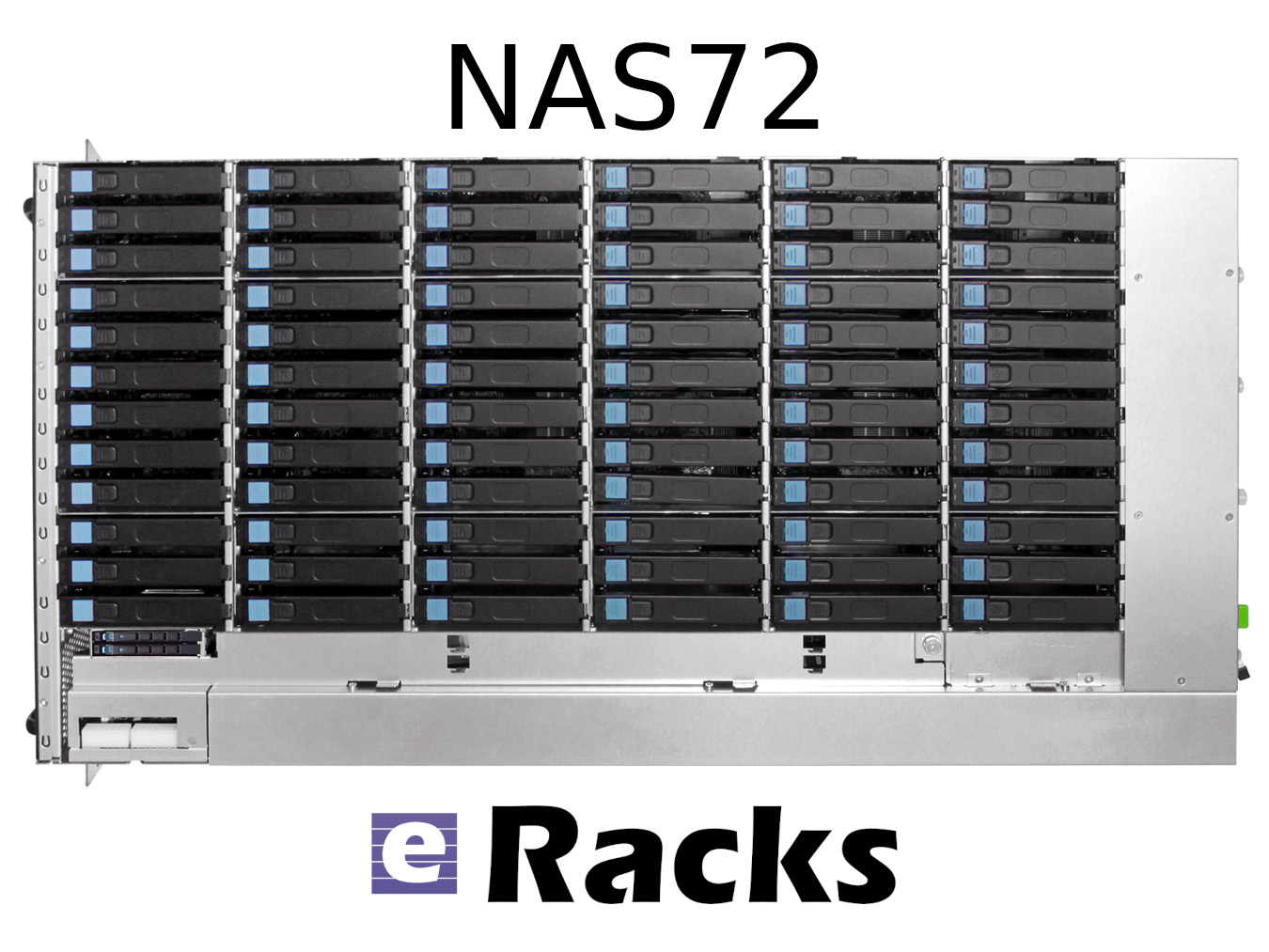
eRacks Open Source Systems has expanded its rackmount NAS server lineup to 11 models, spanning from the 4-bay NAS4 at $1,995 to the 100-bay NAS100 at $29,995. The expansion targets the accelerating cost pressure of cloud storage subscriptions versus on-premise alternatives, with full Linux, ZFS, TrueNAS, and Ceph support across the entire range – and zero per-TB licensing fees.
The math behind on-premise NAS in 2026
Storing 100 terabytes on Amazon S3 costs roughly $27,600 per year in standard-tier fees. The same 100 TB sitting on an eRacks NAS24 – 24 bays, ~480 TB raw capacity – is a one-time $8,995 purchase. Payback is under four months.
Then there are egress fees. A single 100 TB pull from AWS to your office costs around $9,000 just to get your own data back. Cloud storage made sense when the data was small. At terabyte and petabyte scale, the math has flipped.
The lineup at a glance
| Model | Bays | Form Factor | Price (starting) | Best for |
|---|---|---|---|---|
| NAS4 | 4 | 1U or desktop | $1,995 | Branch office, dev team |
| NAS6 | 6 | 1U | $2,995 | Small office, light backup |
| NAS8 | 8 | 2U | $4,995 | SMB primary file server |
| NAS12 | 12 | 2U | $5,995 | SMB with growth headroom |
| NAS16 | 16 | 3U | $6,995 | Mid-tier file + backup |
| NAS24 | 24 | 4U | $8,995 | Mid-enterprise (the bestseller) |
| NAS36 | 36 | 4U | $10,995 | Mid-large workloads, scale-out node |
| NAS50 | 50 | 4U top-load | $14,995 | Media production, surveillance |
| NAS60 | 60 | 4U top-load | $19,995 | High-density archive, large backup |
| NAS72 | 72 | 4U top-load | $24,995 | Broadcast, large-scale archive |
| NAS100 | 100 | 4U top-load | $29,995 | Petabyte-class, Ceph nodes |
Plus a parallel all-flash NAS lineup for performance-tier workloads: FLASH10 ($5,995), FLASH20 ($9,895), FLASH24 ($8,995), FLASH48 ($15,995), and FLASH72 ($19,985) – all-NVMe arrays for database backends, AI training datasets, virtualization storage, and any workload that needs IOPS rather than raw capacity.
Open source the whole way down
Every eRacks NAS ships with full Linux – not a locked appliance OS – and supports your choice of:
- ZFS with ECC RAM for data integrity
- TrueNAS Scale for the friendly web UI experience
- Ceph for clustered scale-out
- MinIO for S3-compatible object storage
- Nextcloud for private cloud file sharing
- OpenMediaVault for the lightweight option
- Proxmox if you want NAS + VMs in one box
No vendor licenses. No per-TB fees. Full root access. You own the OS, you own the data, you own the hardware.
Hardware standards across the line
ECC RAM as standard. Hot-swap drive bays throughout. Redundant power supply options on NAS12 and above. NVMe SSD caching on larger models for accelerated reads. 25 GbE networking on demand for AI training workloads, video production pipelines, and large-scale backup.
The lineup also scales without chassis replacement. A NAS50 shipping with 24 drives today expands to 50 as needs grow – no forklift upgrade required.
When does it pay off?
For most organizations storing more than 5 TB of business data, on-premise NAS is cheaper than cloud subscriptions in year one. For HIPAA-aligned healthcare deployments, law firms protecting privileged data, or any organization with data sovereignty requirements, on-premise is not just cheaper – it is the right architecture.
Custom-built since 1999
eRacks Open Source Systems has designed, built, and shipped custom Linux servers since 1999. Every system is configured to order, burn-in tested before shipping, and supported directly by engineers who built it. No call centers, no upsell scripts, no per-feature licensing.
Get a quote
The full NAS lineup is at eracks.com/products/rackmount-nas-servers. Contact us for a custom quote sized to your specific capacity, performance, and software-stack requirements.
joe April 29th, 2026
Posted In: Backups, Linux, NAS24, NAS50, NAS72, Storage
Tags: backup, Best-Practices, Cloud Storage Server, eRacks/NAS24, eRacks/NAS50, NAS, NAS24, NAS72, near-line storage, Storage, Storage Server
8TB Western Digital Red and RedPro now available
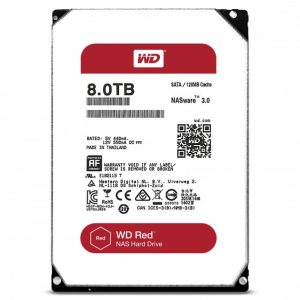
 8TB WD Red and RedPro drives are now available in the dropdowns on all eRacks NAS Systems, and are available on select other eRacks systems, and of course all eRacks systems by custom quote –
If you don’t see it on the system you want, just ask & we’ll quote you!
j
joe December 3rd, 2016
Posted In: Backups, NAS24, NAS36, NAS50, NAS72, servers
Upgraded eRacks/NAS24 – 200-TB-class Storage for $14,880
We’ve upgraded our popular eRacks/NAS24 rackmount storage server for higher-storage-density – new 8TB Archive drives allow price-breakthrough $/density of nearly 192TB going for $14,880.
Configurable now, it combines a rack usage of only 4U with a density of 24 drives, which, when combined with the available technology of 8TB drives, yields a total storage configuration of up to 192TB.
What makes eRacks/NAS24 so unique
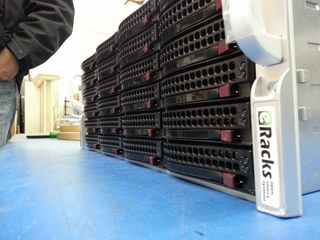
eRacks/NAS24 Storage Server

eRacks/NAS24
Motherboard: eRacks Intel Dual Xeon E5-2600 v2/v3 IPMI motherboard
CPU: Intel Xeon E5-2609 v3 (15M Cache, 1.90 GHz)
Memory: 4GB DDR4 Memory (2133/2400/2666) ECC / REG
Hard Drives: Seagate Archive 5-8TB 3.5″ SATA6 5900RPM SMR Hard Drive
RAID card: RAID 6 (striped with dual parity)
OS: 2x SSD 120GB Samsung 840 EVO or better, Mirrored
Email us at info (at) eracks.com or via our contact page at eracks.com/contact if you have any questions.
Read More in our Press Releases:
PR newswire – http://www.newswire.com/press-release/eracks-announces-upgraded-eracks-nas24-200-tb-class-storage-for
e-releases – http://eracks.com/mar-11-2015-eracks-announces-upgraded-eracks-nas24-200-tb-class-storage-under-20000/
Dennis
eRacks
Dennis April 13th, 2015
Posted In: NAS24, Open Source, Operating Systems, Reviews, servers, Upgrades
Tags: 200TB-class, 8TB, Archive Drives, Cloud Computing, Cloud Storage Server, HDD, Hybrid Cloud, Internet, linux, NAS24, Private Cloud, Rackmount, seagate, Storage Server, ubuntu