
eRacks Systems Tech Blog
Open Source Experts Since 1999
From 144TB to 2.6PB: The 2026 Storage Market and Why On-Premise NAS Is Back
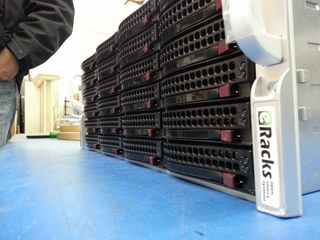
The data storage market in 2026 is doing something unusual: it’s both growing fast and getting cheaper per terabyte at the same time. Global storage requirements are projected to nearly double by 2029, hitting roughly 20,000 exabytes. The NAS hardware market alone is forecast to grow from $55B today to $173B+ by 2034 – a 15.5% CAGR. And while all that’s happening, 30TB+ enterprise SATA drives have become genuinely mainstream, with retail prices that put petabyte-scale on-premise storage within reach of mid-sized organizations for the first time.
Meanwhile, the cloud-storage decade is hitting a wall. Egress fees on AWS, Azure and GCP have only gone up. Ransomware losses keep climbing. Healthcare, legal, finance, and government buyers are all asking the same question they used to leave for the IT department: where, exactly, is our data? The answer “somewhere in us-east-1” doesn’t satisfy a HIPAA auditor, a SOC 2 attestation, or a court order anymore.
The on-premise comeback is a hardware story
For years, the argument against running storage in your own rack was capex vs opex – “cloud is cheaper because you don’t buy hardware.” That math has flipped for any organization storing more than a few hundred TB. A 36-bay NAS loaded with 24TB drives gives you nearly a petabyte of raw storage for the price of about 8-10 months of equivalent S3 storage at production-tier rates – and the hardware keeps working for 5-7 years after that.
Three things made it flip:
- HDD prices at historic lows. 28TB and 30TB enterprise drives now sell for under $20/TB. A decade ago, that was 2TB-drive territory.
- ZFS and modern Linux file systems matured. ZFS in particular – with built-in checksumming, snapshots, replication, and dedup – has become the default storage layer for serious on-premise deployments. No vendor lock-in, no licensing tax.
- Cloud egress is the new vendor lock. Pulling 100TB out of S3 to migrate workloads costs more than the hardware that would store it locally for 5 years.
The eRacks NAS lineup
Our rackmount NAS line covers everything from a small workgroup file server to true petabyte-scale storage chassis. All ship with real Ubuntu Linux (your choice of file system – ZFS, XFS, or Btrfs), enterprise components (ECC RAM, redundant power supplies, hot-swap bays), and zero proprietary management software. The OS is yours, the data is yours, the hardware is yours.
| Model | Form | Bays | Max Raw | Starting |
|---|---|---|---|---|
| NAS4 | 1U | 4 | 144TB | $1,895 |
| NAS6 | 2U | 6 | 180TB | $2,795 |
| NAS8 | 2U | 8 | 240TB+ | $3,695 |
| NAS12 | 2U | 12 | 360TB | $4,695 |
| NAS16 | 3U | 16+2 | 288TB | $6,595 |
| NAS24 | 4U | 24 | 720TB | $8,995 |
| NAS36 | 4U | 36 | ~1PB | $10,495 |
| NAS50 | 9U | 50 | 1.3PB | $13,595 |
| NAS60 | 4U | 60 | ~2PB | $15,995 |
| NAS72 | 4U | 72 | 1.5PB+ | $19,995 |
| NAS100 | 4U | 102 | 2.6PB | $24,995 |
Starting prices are barebones (chassis, motherboard, PSU); add drives, RAM, OS choice at configuration. Custom builds welcome.
What you actually run on it
Because we don’t ship a proprietary OS, you get to pick the storage stack that matches your workload. Common combinations our customers deploy:
- File systems: ZFS (default for most deployments), XFS, Btrfs
- NAS / file sharing: TrueNAS, OpenMediaVault, Samba, NFS, iSCSI
- Distributed storage: Ceph, BeeGFS, MooseFS, LizardFS – for multi-node clusters and HPC workloads
- Object storage: MinIO (S3-compatible) – increasingly popular as a local target for AI/ML training datasets
- Private cloud: NextCloud, Seafile, OwnCloud, Proxmox VE, CloudStack
- Backup & sync: Bacula, BorgBackup, restic, rsync, Duplicati
Pre-installed and tested before shipping, or shipped bare for you to provision however you like – your call at order time.
Who’s actually buying these in 2026
Six segments dominate our NAS pipeline this year:
- SMBs and mid-market IT trying to escape per-GB cloud bills that have crept past the cost of hardware ownership
- Media and production companies with growing 4K/8K video libraries (one production house can fill a 720TB NAS24 in a year)
- Healthcare and medical practices with HIPAA and patient-data sovereignty requirements that rule out major cloud providers
- Legal firms archiving case files, depositions, and discovery materials that simply cannot leave the building
- AI/ML teams needing local high-speed datasets for training – typically pairing a NAS24 or NAS36 with our AI server line for the GPU compute side
- MSPs and IT consultancies building private cloud infrastructure for clients who want SaaS economics without surrendering data ownership
What we don’t do
We don’t build consumer NAS appliances. There’s no fancy iOS app to manage your photos. We don’t license a proprietary OS or lock you into a vendor ecosystem. If you want a four-bay desktop box with a slick web UI for your home media collection, we’re not your shop – and that’s fine, lots of good vendors serve that market.
What we do build: enterprise rackmount storage on standard Linux, configurable to your exact spec, that you fully own and can replace any component on. The same approach we’ve taken since 1999.
Get the configuration right
Drive count, RAID level, networking (10/25/100GbE), RAM (1GB per TB is the rule of thumb for ZFS), and OS choice all matter. Reply to this post or hit our contact page with rough requirements and we’ll spec it for you – usually same day.
joe April 8th, 2026
Posted In: Backups, Linux, Open Source, Rackmount Servers, servers, Storage
Tags: backup, ceph, Cloud Storage Server, eRacks, eRacks signature service, eRacks/NAS24, eRacks/NAS36, eRacks/NAS50, MooseFS, NAS, NAS24, NAS36, NAS50, NAS72, Privacy, Rackmount, sata
A Sad Day – the Demise of Persona / BrowserID
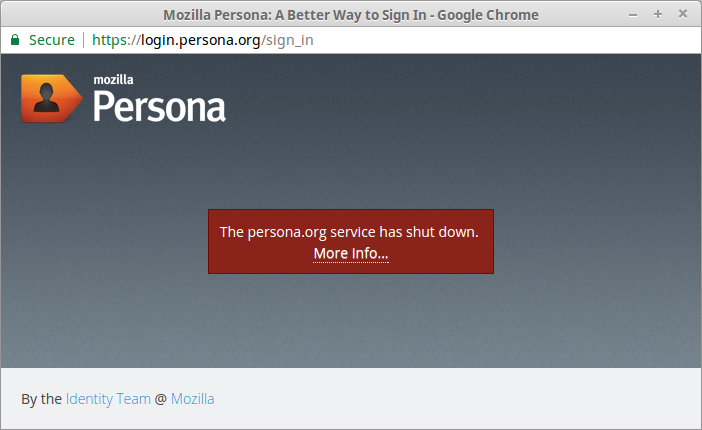
A Sad Day – Mozille BrowserID / Persona Dies
It’s a sad day – the best of the federated Authentication Providers, without its own agenda or privacy issues, has shut down, due to the public’s apparent lack of interest and / or awareness.
Mozilla Persona, which started life several years ago as BrowserID, was the only one of the OpenAuth-based Authentication providers that didn’t insist on being logged in to a commercial site in order to be authenticated by proxy at the time – with all the privacy issues that entails.
Although it’s no secret that The Public is notorious for not caring about (or not even being aware of) privacy (or at least sacrificing it in favor of convenience), it’s unfortunate that the Mozilla Foundation has chosen not to spend the time, effort, and money to educate the public, as it has chosen to do with its other products.
Here are some relevant excerpts from the shutdown page:
FAQs
A website I use requires Persona for login, what should I do?
You will need to contact the site owner and ask about their plans for migrating away from Persona.
Mozilla staff can find more information about the progress of migrating internal sites on this mana page.
Why is persona.org being shut down?
Our metrics show that usage of persona.org is low, and has not grown over the last two years.
Hosting using vps hosting plans at the level of security and availability required for an authentication system is no small undertaking, and Mozilla can no longer justify dedicating limited resources to this project. We will do everything we can to shut it down in a graceful and responsible manner.
What will happen in the meantime?
Between now and November 30th, 2016, Mozilla will continue to support the Persona service at a maintenance level: Security issues will be resolved in a timely manner and the services will be kept online, but we do not expect to develop or deploy any new features. Support will continue to be available on the dev-identity mailing list and in the #services-dev IRC channel.
All websites that rely on Persona will need to migrate to another means of authentication during this time.
What happens after that?
On or after November 30th, 2016, the services hosted by Mozilla on persona.org will be taken offline. This includes the persona.org website, the javascript shim, the fallback IdP and identity bridges, and the hosted verifier.
Mozilla will retain control of the persona.org domain and will not transfer it to a third party. This is a security measure to protect websites that have not completed their migration away from the service.
All user data stored on the persona.org services will be destroyed, including registered email addresses and password hashes. Since the privacy of user data is of utmost importance to Mozilla, we will not transfer it to any third parties.
What about the code?
All of Persona’s code — core, bridges, shims, and more — is open source and remains available on github. Though this marks the end of Mozilla’s direct involvement in Persona, we encourage others to continue learning from and building upon our work.
Migration Suggestions and Guidelines
The following alternative login options are available for sites migrating away from Persona. We will continue to update this page throughout the year.
We intentionally designed Persona to expose email addresses rather than opaque identifiers, which should ease the transition to other systems that provide verified email addresses.
Mozilla-hosted sites may find additional, staff-login-specific migration options on the internal mana page.
Delegated Authentication Providers
Many large email and service providers offer delegated login for third-party applications, including Google, Facebook and GitHub. Indeed, we have found that many sites currently using Persona also offer login via one or more of these services. While these services do not offer equivalently-strong privacy guarantees to Persona, they are a convenient and secure choice for users since they avoid the creation of a site-specific password.
We plan to offer delegated authentication with Firefox Accounts some time in 2016. If you’re interested in adding Firefox Accounts as a login option to your site, please reach out to us on the dev-fxacct mailing list.
Site-Specific Accounts
Many web frameworks offer password-based user accounts functionality out-of-the-box. Although it requires users to create and remember yet another password, it can be a good choice for users who do not have (or do not wish to share) an account with a delegated authentication provider.
For existing users who previously authenticated with Persona, you could consider authenticating them through Persona again to confirm their email address, then prompting them to create a site-specific password.
Passwordless Email Login
As an alternative to setting a site-specific password, you can allow users to login directly via email link, as described in this article and implemented by libraries like passwordless. This can avoid the security implications of users having to create and manage another password, and may be a good fallback option when used in combination with delegated authentication providers.
Self-hosting Persona
Since the code for Persona is open-source, it would be possible for reliers to self-host an instance of the service that is dedicated to their own use.
This approach is not recommended most reliers. Persona has a large and complex codebase that has not seen significant development in several years, and Mozilla will not provide security or maintenance updates after 30th November 2016.
More?
We encourage affected reliers to document any alternative solutions here and to discuss them on the dev-identity mailing list, so that others can benefit from their experience.
- The Portier open source project attempts to replicate much of Persona’s user experience, while being easy to self-host, even on the free tier of PaaS providers like Heroku. Similar to Persona, Portier supports identity-bridging to Gmail. It falls back to passwordless-style login links for everyone else.
Taken from:
https://wiki.mozilla.org/Identity/Persona_Shutdown_Guidelines_for_Reliers
We at eRacks wil be looking into Portier for our own usage, as well.
j
joe January 9th, 2017
Posted In: authentication, News, Open Source
Tags: Firefox, Mozilla, Privacy, Software Freedom