
eRacks Systems Tech Blog
Open Source Experts Since 1999
Hard Drive Prices Jumped 40 to 90 Percent Since March: Six Months of Our Own Tracking
A sale landed in our feed this week: thirty dollars off an 8TB Barracuda. Nice, if you need one drive. It is also completely the wrong number to be watching.
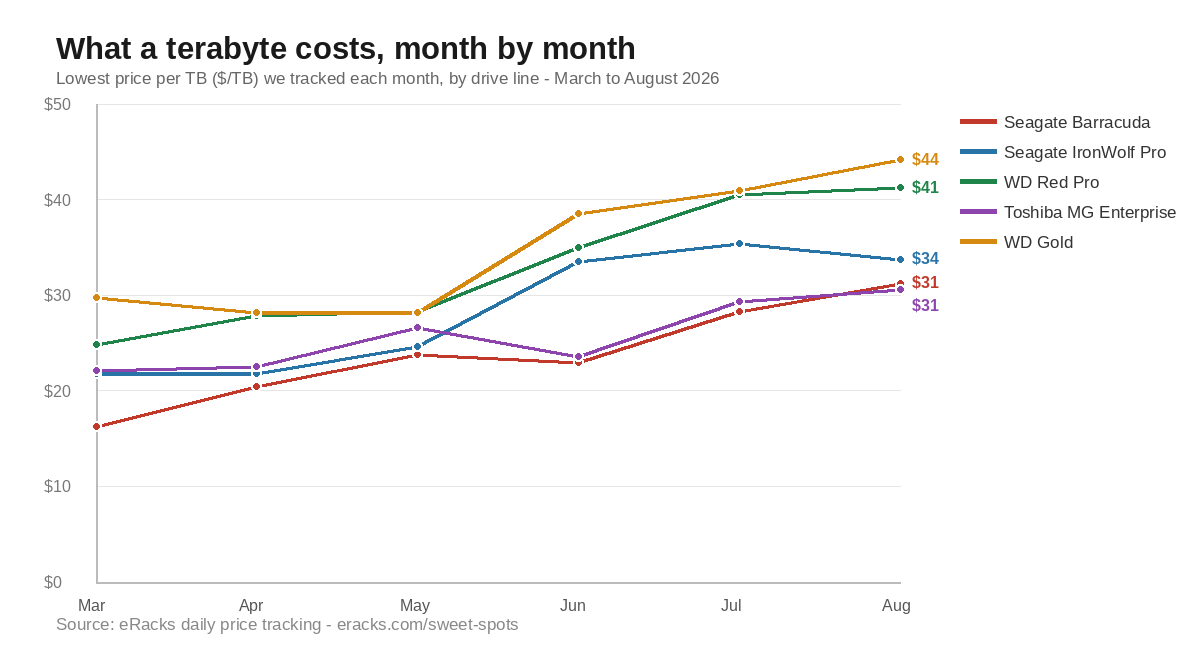
We price storage servers every week, so we track drive street prices daily and keep the results on a public page. The metric that matters is not the sticker on any one drive, it is dollars per terabyte, and over the last six months it has gone one direction.
What actually happened
These are the best prices we found in each month, not averages, so they are the floor rather than the typical ask:
| Drive line | Class | March 2026 | August 2026 | Change |
|---|---|---|---|---|
| Seagate Barracuda | Desktop | $16.25 | $31.25 | +92% |
| WD Red Pro | NAS | $24.84 | $41.22 | +66% |
| Seagate IronWolf Pro | NAS | $21.78 | $33.75 | +55% |
| WD Gold | Enterprise | $29.79 | $44.17 | +48% |
| Toshiba MG | Enterprise | $22.17 | $30.64 | +38% |
| Seagate Exos SATA | Enterprise | $24.33 | $27.92 | +15% |
The consumer line moved most, which is the tell. Desktop drives are the shock absorber of the storage market: they are the first to get discounted when supply is loose and the first to be repriced when it is tight. The enterprise lines with long supply contracts behind them moved least.
Why
The same squeeze that took DDR5 memory prices up this year is reaching spinning storage. AI datacenter buildouts are consuming manufacturing capacity and inventory across the board, and hard drives are being pulled into it as the cheap tier behind all those flash arrays. Meanwhile the drives most people actually buy, the 8TB to 16TB middle, are the ones the shortage bites hardest, because that is where consumer and datacenter demand overlap.
What this means if you are buying storage
Watch $/TB, not the discount. Thirty dollars off an 8TB drive that has already gone up sixty dollars per terabyte since spring is not a deal, it is a smaller increase. Divide the price by the capacity, every time, and compare that number to what the same class cost you last quarter.
The sweet spot moves. The cheapest terabyte is not always in the biggest drive, and in a shortage it moves around by the week. We publish the current best price per TB by capacity and by line, updated daily, at eracks.com/sweet-spots/drives, with the trend lines at the trends view. It is the same data we quote from, so you can check our arithmetic.
Buy the array you need now, not the one you will need in three years. The usual advice, buy extra capacity because it is cheap, assumes prices fall. They are not falling right now. Size the array for real growth, leave bays free, and add capacity when the market gives you a better number rather than paying today’s price for tomorrow’s data.
Fewer, larger drives still wins on the other costs. Even with prices up, a 24TB drive costs less per terabyte to power, cool, and rack than three 8TB drives, and it leaves bays open. The capacity ceiling keeps moving too: the largest drive in our catalog was 14TB in 2019, and it is 32TB today.
How we track it
A scraper walks the drive lines we actually build with, several times a day, records what each capacity costs from real listings, and computes price per terabyte. Every server quote we send is priced from that table on the day we send it, which is also why our quotes carry a refresh note: in a market moving this fast, a four-week-old number is fiction.
If you are sizing a storage server, a rackmount NAS, an all-flash array, or a media and video server, tell us the usable capacity you need and how fast it grows. We will size it against today’s numbers, show you the per-TB math, and tell you if waiting a quarter is the better move.
Common questions
Should I buy now or wait? Prices are not falling right now, so waiting is a bet, not a saving. Size the array for the growth you can actually forecast, leave bays free, and add capacity when the per-terabyte number improves.
Are enterprise drives worth the premium in a shortage? The gap narrowed: Toshiba MG enterprise at $30.64 per TB is now close to what a consumer Barracuda costs at $31.25, and the enterprise drive carries the longer warranty and the workload rating. When consumer pricing catches up to enterprise, buy enterprise.
Do these numbers include the drives in your servers? Yes. Every storage server we quote is priced from this same table on the day we quote it.
Scope note: our own daily tracking began in March 2026, so the chart is six months of first-hand data rather than a multi-year index. The capacity figures come from our catalog history.
joe September 3rd, 2026
Tags: component pricing, Exos, hard drive prices, NAS storage, price per TB, Seagate IronWolf, Storage Server, Toshiba MG, WD Gold, WD Red Pro, ZFS NAS